Why Courier & Logistics Billing Software Works Differently
Courier and logistics billing software has to track AWB (Air Waybill) number as the primary reference — customers and the courier company both use it to trace a shipment, so it needs to sit at the top of the bill, not buried in a notes field.
It also has to bill by weight (actual or volumetric, whichever is higher) and route (from/to), and — for shipments over the threshold — carry an e-way bill number, which most generic invoicing tools don’t have a dedicated field for.
Courier & Logistics GST Bill Format — Required Fields
| Field | Why It’s Needed |
|---|---|
| Invoice number & date | Standard requirement, sequential for the financial year |
| AWB / Tracking No. | Primary reference for shipment tracing |
| Weight | Actual or volumetric, whichever applies |
| From / To | Origin and destination of the shipment |
| Sender / Receiver details | Names and contact for delivery confirmation |
| Delivery Type | Standard, express, same-day, etc. |
| E-way Bill No. | Required for goods movement above the value threshold |
| Total invoice value | Final payable amount, GST included |
Common Billing Challenges for Courier & Logistics
- AWB as the primary reference — every query — status, delivery, dispute — starts with the AWB number, so it needs prominence on the bill
- Weight-based pricing — actual vs. volumetric weight calculations need to be correct and consistent
- E-way bill requirement — shipments above the threshold value need an e-way bill number captured, not skipped
- High shipment volume — courier businesses bill many small shipments daily, needing fast, repeatable billing
- Delivery confirmation — sender and receiver details need to be clear for proof-of-delivery disputes
See BizKhata’s Business Templates in Action
Below is BizKhata’s template gallery — the Courier / Transport / Logistics template sits alongside 45+ other GST-ready formats, pre-configured with the fields this business needs so you’re not building the invoice structure from scratch.
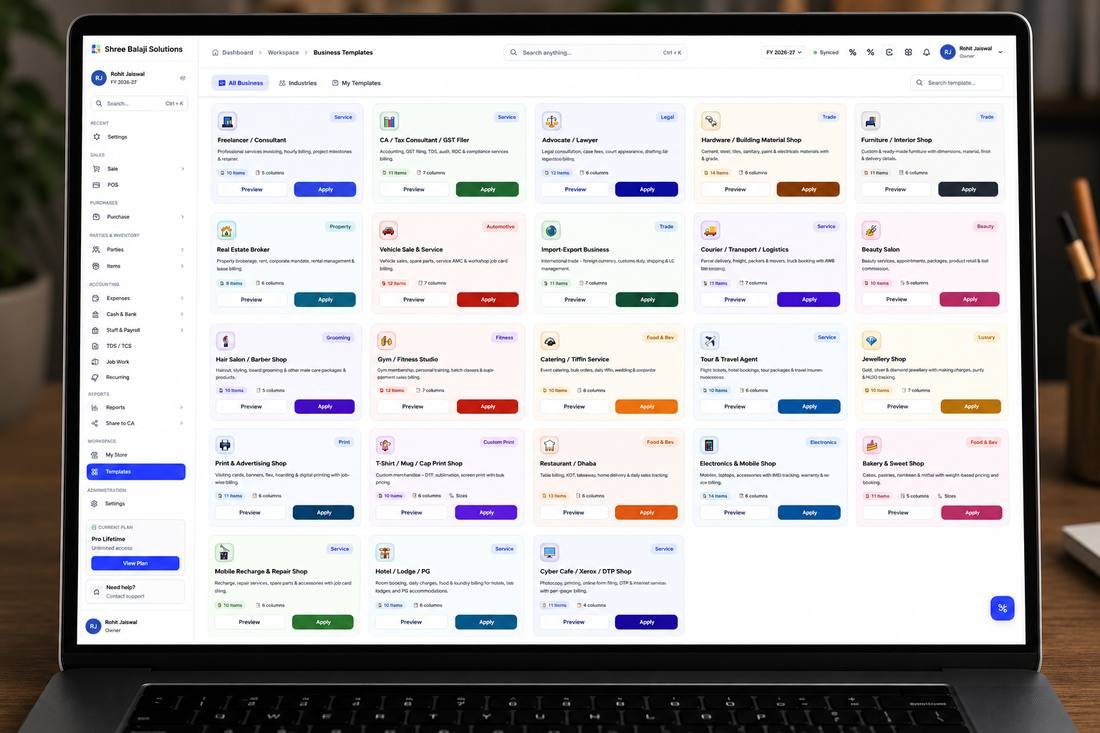
BizKhata’s Courier / Transport / Logistics template, ready to apply with one click
How Courier & Logistics Billing Software from BizKhata Works
- Apply the Courier / Logistics template — AWB, weight and route fields are pre-configured.
- Enter the AWB number — as the primary reference for the shipment.
- Bill by weight and route — from/to and actual or volumetric weight.
- Add e-way bill number — for shipments above the value threshold.
- GST applies automatically — correct rate for transport/logistics services.
- Print or share the bill — for the sender’s records or delivery documentation.
Why Courier & Logistics Choose BizKhata
AWB-First Billing
Shipment tracking reference front and center on every bill.
Weight-Based Pricing
Actual or volumetric weight, calculated correctly.
E-Way Bill Field Built In
Captured on every shipment above the threshold.
High-Volume Ready
Fast, repeatable billing for many daily shipments.
Offline & Reliable
Billing continues even if the internet connection drops.
One-Time Lifetime Plan
No recurring subscription — pay once for a billing system built for logistics.
Related Business Templates
BizKhata includes GST-ready templates for other businesses too — explore the ones closest to yours: