Why Advocates Billing Software Works Differently
Advocate billing software has to track case number (or CNR) and court name on every fee receipt, since legal fees are almost always tied to a specific matter — a client with two ongoing cases needs two clearly separate billing trails, not one combined tab.
It also needs to track the stage of the case (filing, evidence, arguments, judgment) since fees are often billed per stage or per appearance, not as a flat one-time charge like most other service businesses.
Advocates GST Bill Format — Required Fields
| Field | Why It’s Needed |
|---|---|
| Receipt number & date | Standard requirement, sequential |
| Case No. / CNR | Ties the fee receipt to the specific legal matter |
| Court Name | District Court, High Court, Supreme Court, Tribunal, etc. |
| Opposite Party | Identifies the matter clearly when a client has multiple cases |
| Stage of Case | Filing, Evidence, Arguments, Judgment, Appeal — fees often billed per stage |
| Next Date | Useful reference for the client’s own tracking |
| Particulars | Consultation, court appearance, drafting, or other professional service |
| Total fee amount | Final payable amount for that receipt |
Common Billing Challenges for Advocates
- Multiple cases, one client — a client with two matters needs two clearly separate billing trails, not one combined tab
- Stage-wise fee billing — fees are often tied to case stage or appearance, not a flat one-time charge
- Court appearance tracking — per-date appearance fees need to be recorded clearly against the right case
- Reverse charge GST complexity — legal services can fall under forward or reverse charge depending on the client, which most billing tools don’t model
- Disbursements vs. professional fees — court fees and stamp duty paid on the client’s behalf need to be distinguished from the advocate’s own fee
See BizKhata’s Business Templates in Action
Below is BizKhata’s template gallery — the Advocate / Lawyer template sits alongside 45+ other GST-ready formats, pre-configured with the fields this business needs so you’re not building the invoice structure from scratch.
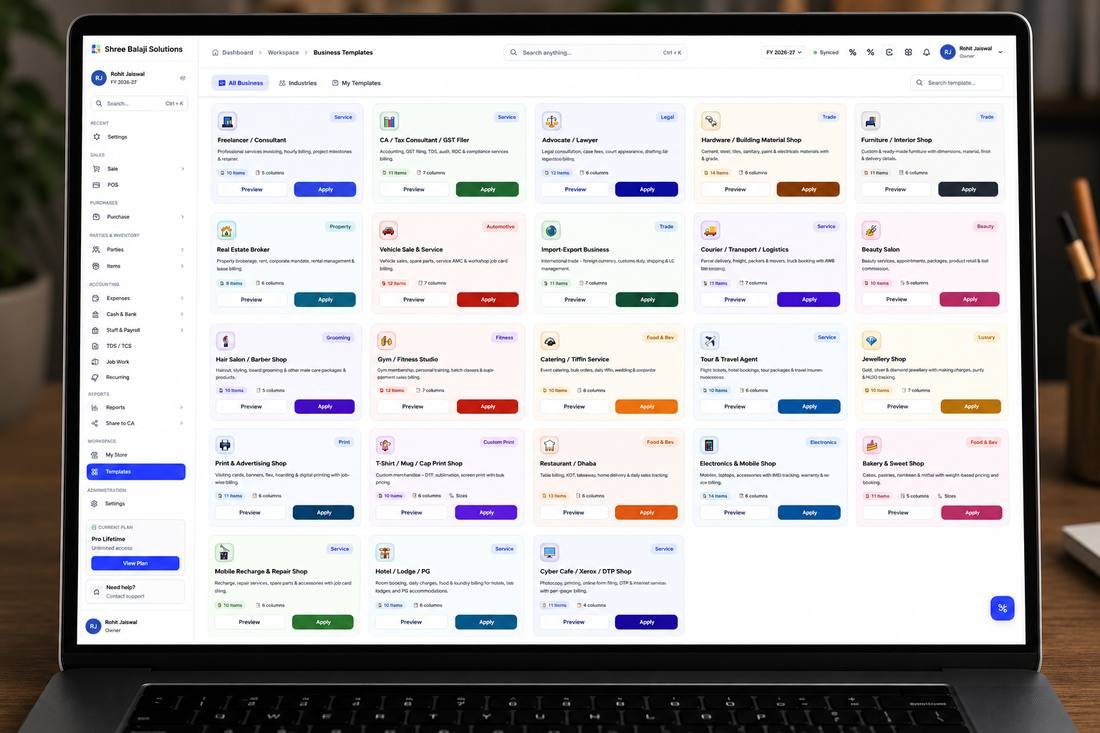
BizKhata’s Advocate / Lawyer template, ready to apply with one click
How Advocates Billing Software from BizKhata Works
- Apply the Advocate / Lawyer template — case number, court name and stage fields are pre-configured.
- Select the case — fee history for that specific matter shows up instantly.
- Bill by stage or appearance — consultation, court date, drafting — each as its own line.
- Separate disbursements from fees — court fees and stamp duty tracked distinctly from professional charges.
- GST applies as applicable — forward or reverse charge, per your engagement type.
- Print or share the receipt — for the client’s records.
Why Advocates Choose BizKhata
Case-Wise Billing
Every fee receipt tied to a specific case number and court.
Stage-of-Case Tracking
Bill by filing, evidence, arguments or judgment stage.
Disbursements, Separated
Court fees and stamp duty kept distinct from professional fees.
Multiple Matters, One Client
Clean, separate billing trails per case.
Offline & Reliable
Billing continues even if the internet connection drops.
One-Time Lifetime Plan
No recurring subscription — pay once for a billing system built for legal practice.
Related Business Templates
BizKhata includes GST-ready templates for other businesses too — explore the ones closest to yours: