Garments Shop Billing Software — GST 2.0 Rates & Bill Format
GST 2.0 changed how garments are taxed — 5% up to ₹2,500 a piece, 18% above it, applied item by item, not per bill. Here's the correct garments bill format under the new rates and how BizKhata handles size, colour and style variants automatically.
What Changed: GST 2.0 on Garments
Effective September 22, 2025, GST 2.0 revised the tax rate on readymade garments under HSN Chapter 61/62. Garments priced at ₹2,500 or less per piece are taxed at 5%, while anything priced above ₹2,500 per piece is taxed at 18% — a sharp jump that makes correct per-item pricing essential, not optional. This threshold applies per piece, so a single bill covering a ₹1,800 shirt and a ₹3,200 kurta needs two different GST rates on the same invoice.
A garments shop bill format has to get two things right at once: apply GST 2.0's price-based slab correctly per item, and track the size/colour/style variant that a plain "shirt x1" line item completely loses. Get either wrong and you either misfile GST returns or lose track of which exact stock moved.
Garments Bill Format — Required Fields
| Field | Why It's Needed |
|---|---|
| Invoice number & date | Standard GST requirement, sequential for the financial year |
| Item / design name | Identifies the garment style being sold |
| Size & colour | Same design, different stock — must be tracked separately |
| HSN code (Ch. 61/62) & GST rate | 5% up to ₹2,500/piece, 18% above — applied per item |
| Per-piece price | Determines which GST slab applies to that specific item |
| Quantity | Pieces or sets, depending on how the item is sold |
| Payment mode | Cash, UPI, card, sometimes split |
| Total invoice value | Final payable amount, GST included |
Common Garments Billing Challenges
- Mixed GST 2.0 slabs on one bill — a budget item and a premium item can sit on the same invoice at different rates
- Size-colour variant stock — a design can be sold out in Medium but still available in Large; tracking by design alone hides this
- Set vs. piece billing — sarees, suits and matching sets need to bill as a unit while still tracking each piece's variant
- Seasonal/discount pricing — a discounted price can shift an item across the ₹2,500 threshold, changing its GST rate
- Returns and exchanges — a customer exchanging Medium for Large needs the stock and sale record updated correctly on both sides
See BizKhata's Business Templates in Action
Below is BizKhata's template gallery — the Garments Shop template sits alongside 30+ other GST-ready formats, pre-configured with size and colour variant fields so you're not building the invoice structure from scratch.
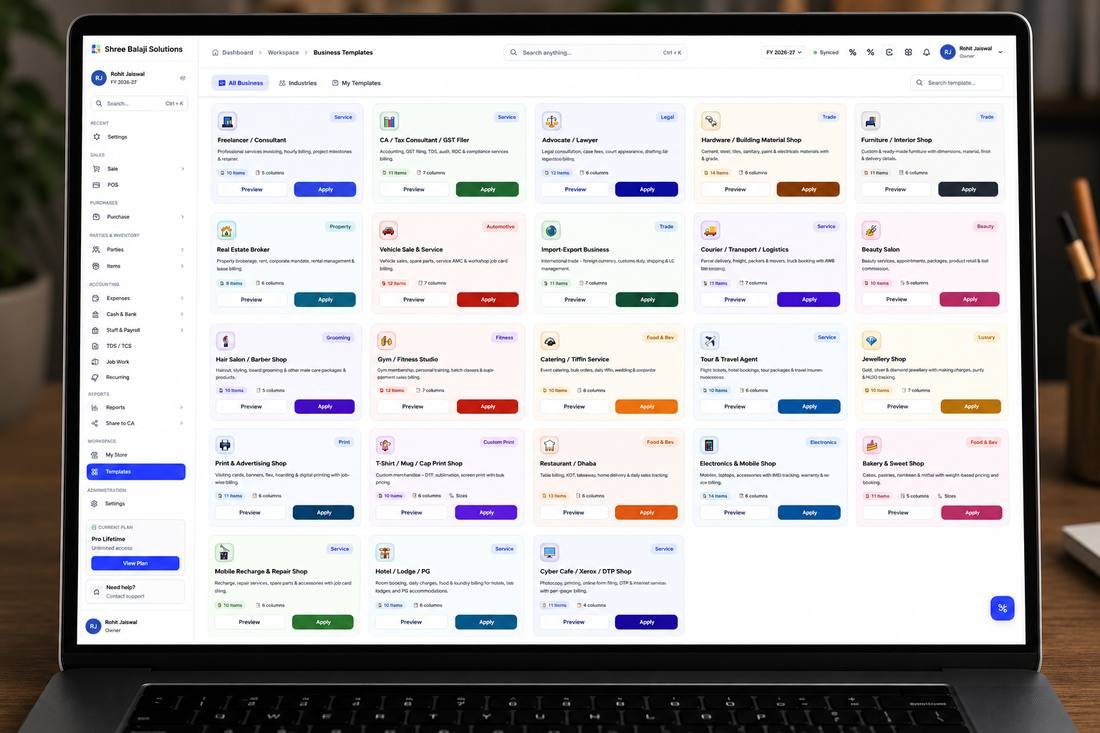
BizKhata's Garments Shop template, ready to apply with one click
How BizKhata Bills a Garments Shop
- Apply the Garments Shop template — size, colour and style fields are pre-configured.
- Pick the design and variant — size and colour selected from that item's own stock.
- GST 2.0 rate applies automatically — 5% or 18% based on that item's actual price, not a fixed shop-wide rate.
- Bill by piece or as a set — sarees, suits and combos billed together while variants stay tracked individually.
- Stock updates per variant — Medium and Large are tracked as separate stock counts, not one shared number.
- Print or share — thermal receipt or WhatsApp bill, GST 2.0-compliant either way.
Why Garments Shops Choose BizKhata
GST 2.0 Ready
5%/18% textile slabs applied automatically per item based on price, no manual rate-checking.
Size & Colour Variants
Each design's variants are tracked as separate stock, not one combined count.
Piece & Set Billing
Bill a saree-blouse set or a matching suit together while keeping variant tracking intact.
Season & Discount Pricing
Discounted prices are still checked against the ₹2,500 threshold correctly, item by item.
Offline & Reliable
Billing continues at the counter even if the internet connection drops.
One-Time Lifetime Plan
No recurring subscription — pay once for a billing system built for variant-heavy retail.
Related Retail & Shop Templates
BizKhata includes GST-ready templates for other retail formats too — explore the ones closest to your business:
Frequently Asked Questions
Under GST 2.0, effective September 22, 2025, readymade garments priced up to ₹2,500 per piece are taxed at 5%, while garments priced above ₹2,500 per piece are taxed at 18%, under HSN Chapter 61/62.
The ₹2,500 threshold applies per piece, not per bill. A single invoice can include some items at 5% and others at 18% depending on each individual garment's price, so billing software needs to apply the rate item by item.
A garments bill needs size, colour and style/variant recorded per item, in addition to the standard invoice number, HSN code, GST rate and quantity, since the same design can be sold in multiple size-colour combinations at different stock levels.
Yes, garments billing software should support both individual piece billing and set/combo billing on the same invoice, since sarees, suits and matching sets are commonly sold together but may need separate size or variant tracking.
Garments billing software with variant-level inventory tracks stock separately for each size-colour combination, so a shop can see that a design is out of stock in Medium but still available in Large, rather than tracking the design as a single stock count.
Yes. BizKhata's Garments Shop template tracks size, colour and style per item, applies the correct GST 2.0 rate automatically based on per-piece price, and generates a GSTR-ready invoice.
Bill Your Garments Shop Right Under GST 2.0
Download BizKhata free for Windows or Mac — size/colour variants, GST 2.0-ready, GSTR-ready.
Download BizKhata Free